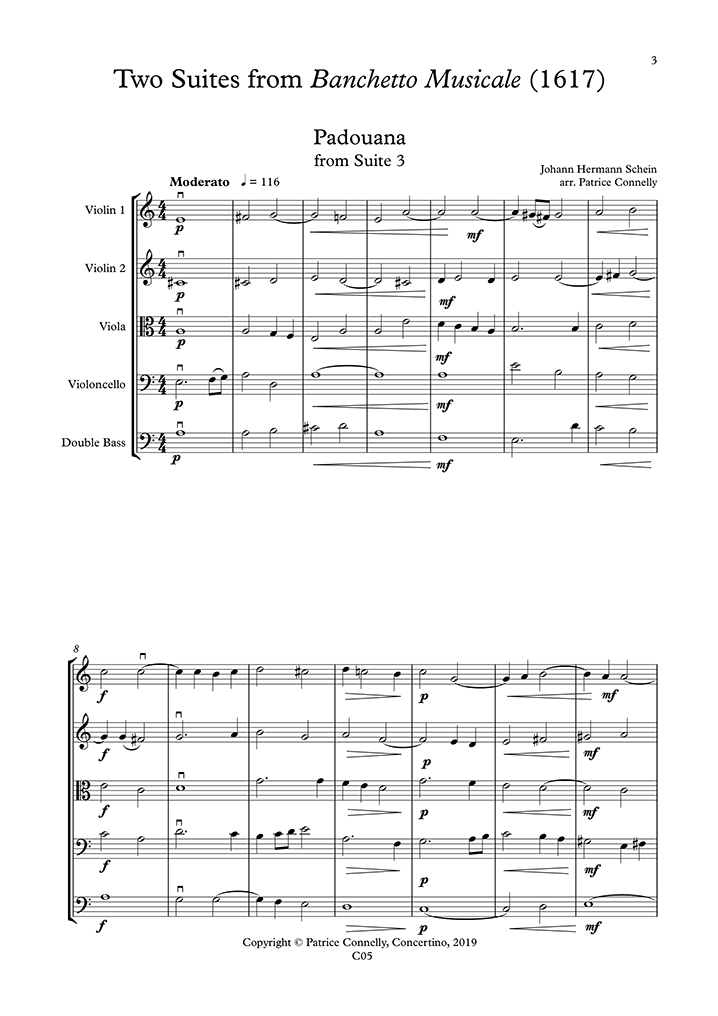
C05 Johann Hermann Schein - Two Suites
arranged for string orchestra by Patrice Connelly A$66 ($60 ex GST)
Background
Johann Hermann Schein (1586 - 1630) was born in Saxony. His father was a Lutheran pastor in Meissen, and died when his son was only about seven. The family moved to Dresden where the young Schein received most of his musical training, including singing in the Hofkapelle. Positions in Leipzig and Weimar followed, and in 1616 he returned to Leipzig where he became Kapellmeister, a position later held by J.S. Bach.
Schein's health was not good, and he contracted tuberculosis, dying in 1630. While there is no obvious evidence of travels to Italy, it is clear that Schein was familiar with the new Italian baroque style, and it is reflected in his later works.
Banchetto Musicale was published in 1617, and consists of twenty suites of dances, plus two additional dances at the end. Schein did not call these suites; they were simply dances grouped by key.
For this edition, I have taken two dances from two "suites", nos 3 and 15. Both have pavans, which is a slow walking dance. From Suite 3 this is paired with a galliard, which was a jumping dance in triple time. They typical galliard rhythm is that of "God Save the Queen", but somewhat quicker in tempo. It's said that Queen Elizabeth I was very keen on dancing galliards. The second piece from Suite 15 is a Courente, likewise reasonably lively in tempo.
In this edition all note values are original, but modern clefs and barlines have been added. All dynamics, metronome markings, tempi and articulations are purely editorial and can be changed. The double bass part has been altered in most pieces, mainly by transposing up or down the octave to better fit the range of the instrument. But that part was the original bassline which Schein wrote.
If performing these in a school environment where students are unfamiliar with the dances, it could be advisable to look for some videos to show the style of each dance. Look particularly for videos where the performers are in costume, as this will give a more realistic view of how the dances are performed, and where there may be some limitations imposed by the costumes.
But overall, play these well-written pieces by an important early composer so that they are heard and enjoyed.
Roughly grade 3 standard. More applicable to community orchestra or senior high school.
© Patrice Connelly, 2019